
Lojas Renner S.A. at COP27
Lojas Renner S.A. has been treading a journey for the transformation of the Brazilian textile market. The company is committed to the evolution of its fashion and lifestyle ecosystem in line with the best sustainability practices, engaging its supply chain, partners, consumers and employees in an effort to increasingly reduce the sector’s environmental impact.
In 2021, the company delivered its first cycle of public sustainability commitments, concluding important goals – and has already launched a new cycle, with even bolder goals, for 2030. Within this context, Lojas Renner S.A. was invited to participate, for the first time, in the United Nations Conference on Climate Change 2022 (COP 27), which took place in Egypt last November.
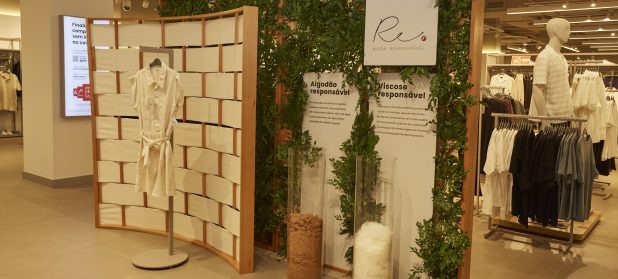
Participation in the event was essential to build bridges in search of new solutions capable of accelerating the objective of making its products and processes increasingly sustainable. The company was able to participate in two panels at the event. The first, with Ana Cecilia Anselmi (Senior Research Manager), focused on the company’s main responsible fashion collections. The second panel was chaired by Eduardo Ferlauto (General Sustainability Manager) and brought Lojas Renner’s strategic perspective on advances in sustainability, with a focus on innovation, technology and cooperation, as well as science-based goals to reduce greenhouse gas (GHG) emissions.
The new cycle of public commitments by Lojas Renner foresees, for example, the transition to the decarbonization of the business with scientifically based metrics in order to reach climate neutrality (net zero) in 2050. For this, the objectives until 2030 include, for example , a goal tested and approved by the SBTi (Science Based Targets Initiative), to ensure that clothing developed by its own brands emits 75% less CO2. Another goal foresees that 100% of the garments have sustainability attributes and are less impactful, such as the use of screened and certified cotton and circular and regenerative raw materials, in addition to lower water consumption in the production process.
Some results from the previous cycle have already affected the company’s commitment to the theme: indicators such as 100% of corporate energy consumption from low-impact renewable sources (solar, wind and small hydroelectric plants) and a reduction of 35.4% in absolute corporate CO2 emissions. The company also reached the level of using 100% certified cotton in its brands’ clothing and the socio-environmental certification of 100% of the global supply network of products for resale.
The strategy now follows along with the employees, on a constant basis – the path to face climate change and global warming in the coming years.